
Farm tires
Agricultural Tires
Agricultural tires cover everything on the farm that rolls: tractor rears and fronts, compact tractors, implements, wagons, spreaders and loaders. We supply them new and used, in bias and radial, for farms in the USA and Europe. Pick your machine below or look up your size.
- New & usedcondition options
- 20brands sourced
- About 1 weekshipping to the USA & Europe
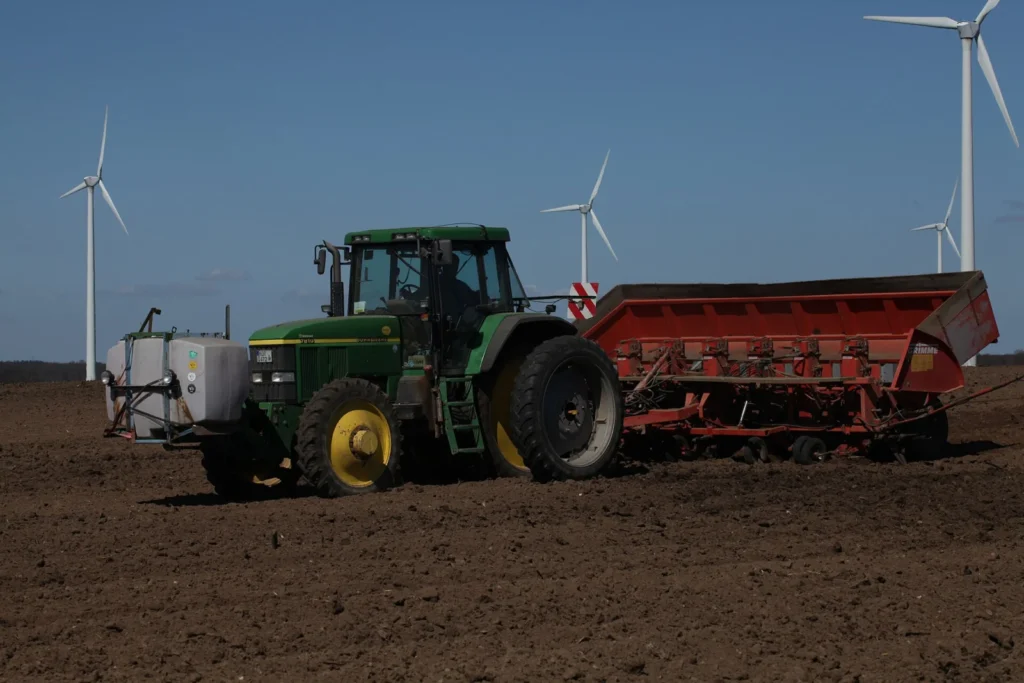

Agricultural tires are the tires built for farm machines: tractors, implements, wagons, grain carts, sprayers, combines and loaders. The right one depends on four things: the size on your sidewall, the tread for your ground, radial or bias, and the load it carries. We supply them new and used for farms in the USA and Europe. (Yes, we read sidewalls for fun. Tread carefully around us at parties.)
Where do you start: which tire for which machine?
Every wheel on a farm has one job. Drive tires pull. Front tires steer. Implement tires roll and carry weight. Pick your machine below, or jump to the size you already have.
- Tractor tiresRear, front, radial and compact tractor sizes, R-1, R-1W and F-2 tread.
- Implement tiresPlanters, drills, rakes, wagons and trailers, I-1 rib and traction treads.
- Flotation tiresWide, low-pressure tires for grain carts, spreaders and heavy wagons.
- Industrial and skid steer tiresR-4 loader tires and skid steer sizes for yards and hard ground.
- Wheels and rimsFarm wheels to go with your tires, new and used.
- Rubber tracksTracks for agricultural and compact equipment.
| Position | Usual tire | What matters most |
|---|---|---|
| Tractor rear (drive) | R-1 or R-1W lug, bias or radial, such as 18.4-38 or 520/85R38 | Traction and tread life |
| Tractor front | F-2 rib on two-wheel drive; a lug tire on front-wheel assist | Steering grip, and a size that matches the rear |
| Implements, wagons, trailers | I-1 rib or a traction tread | Load capacity and free rolling |
| Grain carts, spreaders | Flotation, wide and low pressure | Footprint on soft ground |
| Combines, sprayers | IF or VF radial | Load at low pressure |
| Loaders, skid steers | R-4 industrial lug | Cut resistance and stability |
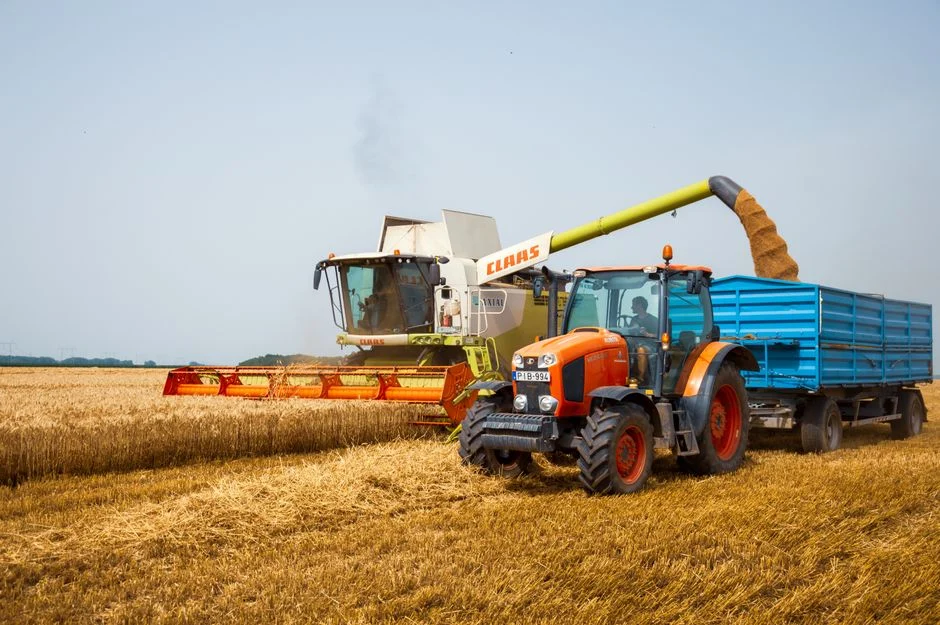
Combine and harvester tires are the odd ones out: they carry the heaviest loads on the farm and spend most of the year parked. If that is your machine, read the IF and VF section below before you buy.
What do the tread codes R-1, R-1W, R-3 and F-2 mean?
The tread code tells you what the tire was built for. Match it to the ground you work most.
| Code | Tread | Best for |
|---|---|---|
| R-1 | Standard farm lug | Field work, tillage and hauling on farm soil |
| R-1W | Deeper lugs (about 20% more) | Wet or heavy soil, high-hour tractors |
| R-2 | Very deep lugs | Rice paddies, cane fields, flooded ground |
| R-3 | Shallow turf tread | Lawns, orchards, vineyards and grounds care |
| R-4 | Industrial lug | Loaders, backhoes and yard work on hard surfaces |
| F-2 | Ribbed front | Steering tires on two-wheel-drive tractors |
| I-1 | Implement rib | Free-rolling wheels on wagons, rakes and trailers |
Not sure which one you need? The tread type picker asks a few questions and points you to a code. Our tread types guide explains each code, and R-1 vs R-1W covers the most common choice.
Radial or bias: which one earns its keep?
Radial farm tires, such as 520/85R38, have flexible sidewalls that put a longer footprint on the ground. That means better traction, less soil compaction and usually longer tread life. Bias tires, such as 18.4-38, cost less and have stiff sidewalls that suit loader and utility work. We are not biased. Well, one of them is.
The University of Kentucky Extension notes that radials are more fuel efficient than bias-ply, but need more careful pressure management. For tractors that log many field hours, radial usually pays for itself. For a low-hour utility tractor that mostly loads and hauls, bias is often the better value. Read the full comparison in radial vs bias tractor tires.
What do IF and VF mean on combine and sprayer tires?
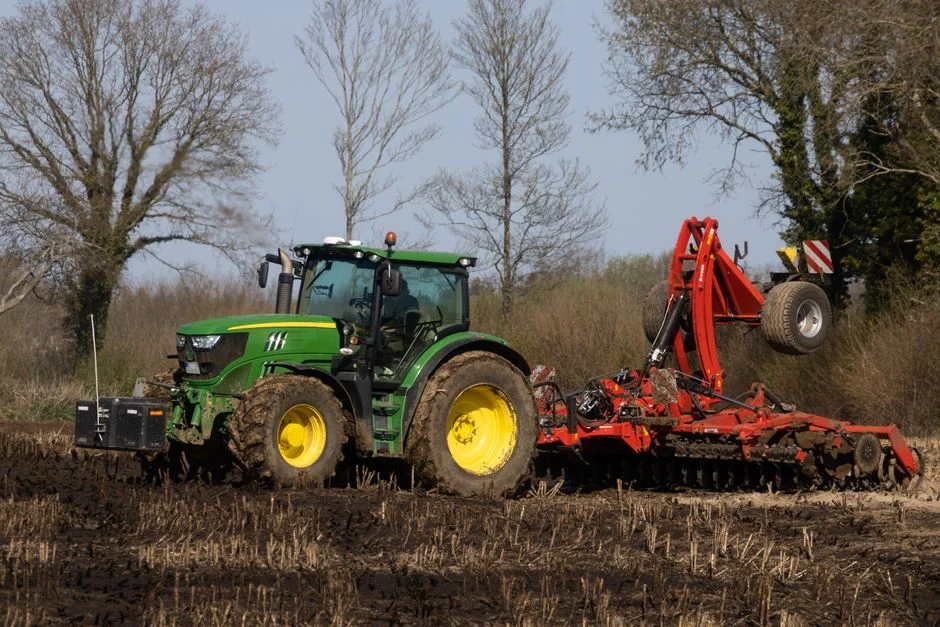
IF stands for Increased Flexion and VF for Very High Flexion. Both are radial tires with a casing built to flex more, so they carry the same load at a lower pressure. One manufacturer says IF and VF tires carry 20% to 40% more load than a standard radial, or run 20% to 40% less pressure. Lower pressure gives a longer, more even footprint and less soil compaction.
The catch: the wheel and the machine must be rated for the tire. See IF vs VF tires for the difference between the two. Some tires just know how to stay on top of things, and flotation tires are the best example.
How do you read the size on an agricultural tire?
Answer first: the first number is the width, the last number is the rim diameter. In 18.4-38, the tire is 18.4 in (467 mm) wide and fits a 38 in (965 mm) rim. The dash means bias-ply. In 520/85R38, the tire is 520 mm (20.5 in) wide, the sidewall is 85% as tall as the tire is wide, the R means radial, and the rim is 38 in.
The old inch sizes map to metric. Multiply inches by 25.4 to get the width in millimeters, and assume an 85% aspect ratio. These pairs are common equivalents:
| Old inch size | Metric equivalent | Width |
|---|---|---|
| 14.9-28 | 380/85R28 | 14.9 in (378 mm) |
| 16.9-38 | 420/85R38 | 16.9 in (429 mm) |
| 18.4-34 | 460/85R34 | 18.4 in (467 mm) |
| 20.8-38 | 520/85R38 | 20.8 in (528 mm) |
Our size guide and size converter do the sums for you. For a second opinion, the sidewall ID reference from AG Tire Talk covers the markings, speed ratings and serial numbers.
What does a worked sizing example look like?
Overall diameter is the number that decides whether a tire fits. The sum is rim diameter plus two sidewalls. Here are two common rear sizes on the same 38 in rim.
| Size | Width | Sidewall (85%) | Overall diameter |
|---|---|---|---|
| 18.4-38 | 467 mm (18.4 in) | about 397 mm (15.6 in) | about 1,759 mm (69.3 in) |
| 520/85R38 | 520 mm (20.5 in) | 442 mm (17.4 in) | 1,849 mm (72.8 in) |
The gap is about 90 mm (3.5 in) in diameter. That is why you never put one of each on the same axle, and why a front-wheel-assist tractor needs front and rear sizes that work together. Check your numbers with the tire diameter calculator, and use the lead-lag calculator for the front-to-rear match.
What do the load index and speed rating tell you?
The load index says how much weight the tire carries at its rated pressure. The speed symbol says how fast it can carry it. Speed symbol A8 is 25 mph (40 km/h), B is 31 mph (50 km/h) and D is 40 mph (65 km/h). A tire marked 155/152A8 carries the A8 symbol, so 25 mph is its limit. The load index and speed rating tool decodes any pair in a few seconds.
If you drive on the road a lot, check the speed symbol before the tread. A tire built for 25 mph is the wrong tire for a 40 mph transport run.
What do our own listings show about farm tire sizes?
We list 69 tire models with 465 size listings. Of those models, 29 are radial and 40 are bias. Sixteen are titled R-1, fourteen R-1W, eight F-2 and eight I-1. Here are the sizes that appear in the most models.
| Size | Models listing it | Typical use |
|---|---|---|
| 520/85R38 | 14 | Large rear radial |
| 380/85R24, 420/85R28, 460/85R30 | 15 each | Mid-size radial rears |
| 320/85R24, 340/85R24 | 14 each | Smaller radial rears and fronts |
| 18.4-34, 18.4-38, 18.4-30 | 12 each | Bias rear workhorses |
| 6.00-16, 6.50-16, 7.50-16 | 11 each | Front tractor and implement |
The honest takeaway: the 85-series radial rears are the most listed sizes we have, and the biggest tractor rim in the list is the 42 in (1,067 mm) of the 710/70R42. Browse them all in our tire catalog or on the tire sizes page.
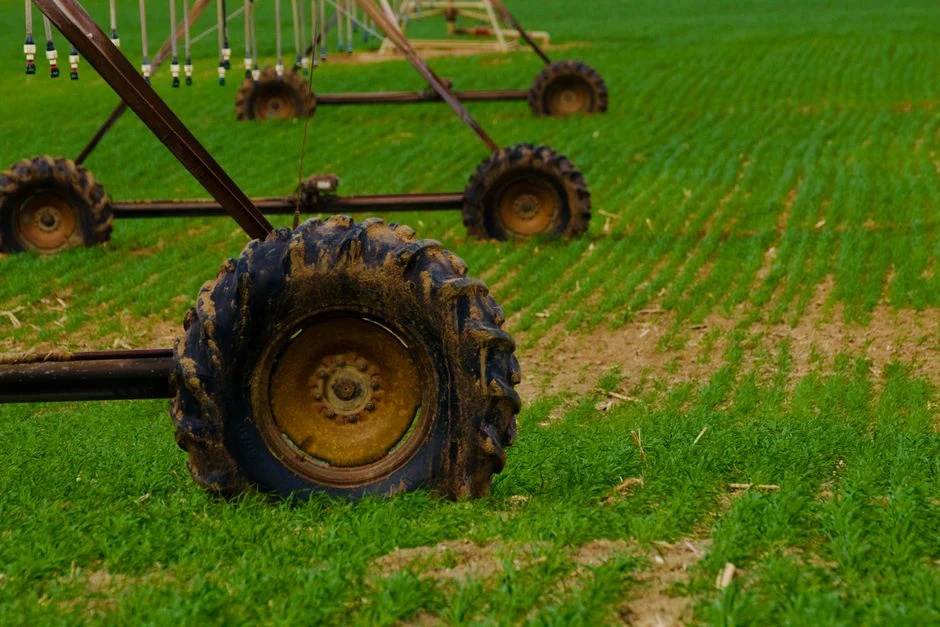
What pressure should agricultural tires run?
Run the lowest pressure the manufacturer's load table allows for your load. The University of Kentucky Extension also gives slip targets: about 10% for front-wheel-assist and four-wheel-drive tractors, 13 to 15% for two-wheel drive, and about 6% for tracks. Ignoring the maker's recommendations can void the tire warranty, so keep the load table handy.
Light load, high pressure is a pressurised conversation nobody wins. Traction drops and the tire wears faster. Use our tire pressure guide and ballast calculator to land in the right range.
How do you choose agricultural tires in five checks?
- Read the size on your current tire. Write down width, aspect ratio and rim diameter.
- Pick the tread for your ground. R-1 for most farm soil, R-1W for wet or heavy soil, R-3 for turf.
- Decide radial or bias. Many hours in the field or on the road favors radial.
- Check load index and speed symbol. Both must cover your heaviest job.
- Match the pair. Replace tires in pairs on the same axle, and keep front and rear sizes in step.
Before you ask for a quote, have this ready:
- The full size from the sidewall, or a photo of it
- The tread code, or a note on the ground you work
- Radial or bias, and the machine it goes on
- New or used, and how many tires
- Your delivery country
Which mistakes cost the most when buying farm tires?
- Buying one new tire to sit beside a worn one. The different diameters make the axle fight itself.
- Running full pressure for a light load.
- Choosing by price per tire. Tread life and hours matter more. Our tractor tire cost guide shows the sums.
- Ignoring the date code. The last four digits show the week and year of manufacture, per NHTSA. A 0308 tire was made in week 3 of 2008.
- Skipping a photo of a used tire. Ask us for photos of the actual tire, then read our used tire inspection guide.
- Mixing radial and bias on the same axle.
How do you pay less for agricultural tires?
Honest answer: buy the right tire once. Beyond that, three things help.
- Buy used for machines with low yearly hours, older tractors and spare wheels.
- Send us the exact size and tread code, so the quote matches the tire you need and not a near miss.
- Ask for the metric equivalent too. A second size can fit the same rim, and the quote may differ.
Should you buy new or used?
| New | Used | |
|---|---|---|
| Tread | Full depth | Ask for the percent remaining |
| Date code | Fresh | Ask for the DOT date code |
| Best for | High-hour tractors, road work | Older tractors, spare wheels, low yearly hours |
| Proof | Sidewall photo on request | Photos of the actual tire on request |
When you buy used, ask for photos of both sidewalls, the tread percent and the date code. Replace tires in pairs on the same axle.
When should you not buy new agricultural tires?
Skip new tires if your tread is still above half and the sidewalls are clean. Skip radials on a low-hour utility tractor that mostly loads and hauls, because bias tires are often the better value there. And skip the whole category if the machine runs on rubber tracks. For that, see rubber tracks.
Next, send us your size or a sidewall photo on WhatsApp, or ask for a quote. Shipping to the USA and Europe takes about 1 week, and payment is by Zelle. We will probably make a tread joke. The joke is free.
Common agricultural tire sizes
Each page decodes the size in inches and millimeters and explains what to check before you buy.
Not listed? Browse all tire sizes, or send us the size from your sidewall.
Questions
What are agricultural tires?
Tires made for farm machines: tractors, implements, wagons, sprayers, combines and loaders. They use tread codes such as R-1 for field work, R-3 for turf and I-1 for implements, and come in bias and radial construction.
What is the difference between R-1 and R-1W?
R-1W has lugs about 20% deeper than R-1. It grips better in wet soil and lasts longer, so it suits tractors that do a lot of field hours.
Are radial farm tires worth it?
For tractors that do a lot of field work or road travel, usually yes: more traction, less compaction and better fuel efficiency. For low-hour utility and loader tractors, bias tires are often the better value.
What is the best tread for agricultural tires?
R-1 suits most farm soil. R-1W has deeper lugs for wet or heavy ground, R-3 is for turf and R-4 for loaders. Choose by the ground you work most.
What do IF and VF mean on a tire?
IF is Increased Flexion and VF is Very High Flexion. Both are radials that carry the same load at lower pressure, common on combines and sprayers.
How do I read an agricultural tire size?
The first number is the width and the last is the rim diameter. In 18.4-38 the width is 18.4 in (467 mm) and the rim is 38 in (965 mm). In 520/85R38 the width is 520 mm, the sidewall is 85% of that, and R means radial.
What tire pressure should I run on a tractor?
Run the lowest pressure the manufacturer load table allows for your load. Check the load table for your exact size and axle weight, because the right figure changes with both.
Can I mix radial and bias tires on a tractor?
Not on the same axle. Pairs should match in type and size. Front and rear sizes also need to work together on a front-wheel-assist tractor.
Do you sell used agricultural tires?
Yes, new and used. For used tires we can ask the supplier for photos of the actual tire. Send us your size and we will quote.
How long does shipping take and how do I pay?
Shipping to the USA and Europe takes about 1 week. We quote shipping to your location with the tire prices. Payment is by Zelle.