
85 sizes
Tractor & Farm Tire Sizes
These tire sizes cover every tractor, implement, flotation, skid steer and industrial tire we supply, new and used. Open a size to see what the numbers mean and where it is used, then get a price on WhatsApp or request a quote.
Rear Tractor Tires
| Size | Tread | Construction | Typical use | Add to quote |
|---|---|---|---|---|
| 12.4-24 | R-1 | Bias | Utility / row crop | |
| 13.6-24 | R-1 | Bias | Utility / row crop | |
| 14.9-24 | R-1 | Bias | Utility / row crop | |
| 16.9-24 | R-1 | Bias | Utility / heavy tractor | |
| 18.4-24 | R-1 | Bias | Utility / heavy tractor | |
| 23.1-26 | R-1 | Bias | Heavy tractor | |
| 28L-26 | R-1 | Bias | High flotation / heavy tractor | |
| 11.2-28 | R-1 | Bias | Compact / row crop | |
| 12.4-28 | R-1 | Bias | Row crop / utility | |
| 13.6-28 | R-1 | Bias | Row crop / utility | |
| 14.9-28 | R-1 | Bias | Utility / row crop | |
| 16.9-28 | R-1 | Bias | Heavy utility | |
| 18.4-28 | R-1 | Bias | Heavy utility | |
| 20.8-28 | R-1 | Bias | Heavy tractor | |
| 12.4-30 | R-1 | Bias | Row crop / utility | |
| 13.6-30 | R-1 | Bias | Row crop / utility | |
| 14.9-30 | R-1 | Bias | Utility / row crop | |
| 16.9-30 | R-1 | Bias | Heavy utility | |
| 18.4-30 | R-1 | Bias | Heavy utility | |
| 20.8-30 | R-1 | Bias | Heavy tractor | |
| 12.4-32 | R-1 | Bias | Row crop | |
| 14.9-32 | R-1 | Bias | Row crop | |
| 24.5-32 | R-1 | Bias | Heavy tractor | |
| 16.9-34 | R-1 | Bias | Utility / row crop | |
| 18.4-34 | R-1 | Bias | Heavy utility | |
| 20.8-34 | R-1 | Bias | Heavy tractor | |
| 23.1-34 | R-1 | Bias | Heavy tractor | |
| 13.6-36 | R-1 | Bias | Row crop | |
| 14.9-38 | R-1 | Bias | Row crop | |
| 16.9-38 | R-1 | Bias | Heavy row crop | |
| 18.4-38 | R-1 | Bias | Heavy row crop | |
| 20.8-38 | R-1 | Bias | Heavy tractor | |
| 23.1-38 | R-1 | Bias | Heavy tractor |
Radial Tractor Tires
| Size | Tread | Construction | Typical use | Add to quote |
|---|---|---|---|---|
| 320/85R24 | R-1W | Radial | Row crop / utility | |
| 340/85R24 | R-1W | Radial | Row crop / utility | |
| 380/85R24 | R-1W | Radial | Row crop / utility | |
| 420/85R24 | R-1W | Radial | Heavy utility | |
| 420/85R28 | R-1W | Radial | Heavy utility | |
| 600/65R28 | R-1W | Radial | High horsepower tractor | |
| 460/85R30 | R-1W | Radial | Heavy utility | |
| 480/80R34 | R-1W | Radial | Row crop / utility | |
| 520/85R38 | R-1W | Radial | Heavy row crop | |
| 650/65R38 | R-1W | Radial | High horsepower tractor | |
| 710/70R42 | R-1W | Radial | High horsepower tractor |
Front Tractor Tires
| Size | Tread | Construction | Typical use | Add to quote |
|---|---|---|---|---|
| 5.00-15 | R-1 | Bias | Front axle / row crop | |
| 11L-15 | F-2 | Bias | Front axle / row crop | |
| 5.50-16 | R-1 | Bias | Front axle / utility | |
| 6.00-16 | R-1 | Bias | Front axle / utility | |
| 6.50-16 | R-1 | Bias | Front axle / utility | |
| 7.50-16 | R-1 | Bias | Front axle / utility | |
| 7.50R16 | — | Radial | Front axle / utility | |
| 8.3-16 | R-1 | Bias | Front axle / row crop | |
| 9.5-16 | R-1 | Bias | Front axle / utility | |
| 10.00-16 | R-1 | Bias | Front axle / utility | |
| 11L-16 | F-2 | Bias | Front axle / utility | |
| 12.4-16 | R-1 | Bias | Front axle / utility | |
| 9.00R20 | R-1 | Radial | Front axle / heavy utility |
Compact & Garden Tractor Tires
| Size | Tread | Construction | Typical use | Add to quote |
|---|---|---|---|---|
| 18x8.50-10 | R-3 | Bias | Lawn / garden tractor | |
| 20x8.00-10 | R-3 | Bias | Lawn / garden tractor | |
| 23x8.50-12 | R-3 | Bias | Lawn / garden tractor | |
| 26x12.00-12 | R-3 | Bias | Lawn / garden tractor | |
| 27x8.50-15 | R-1 | Bias | Compact utility tractor | |
| 9.5-16 | R-1 | Bias | Compact utility tractor | |
| 11.2-24 | R-1 | Bias | Compact / utility tractor | |
| 12.4-24 | R-1 | Bias | Compact / utility tractor |
Implement Tires
| Size | Tread | Construction | Typical use | Add to quote |
|---|---|---|---|---|
| 9.5L-14 | I-1 | Bias | Implement / wagon | |
| 5.00-15 | I-1 | Bias | Trailer / implement | |
| 5.90-15 | I-1 | Bias | Trailer / implement | |
| 11L-15 | I-1 | Bias | Implement / wagon | |
| 12.5L-15 | I-1 | Bias | Implement / wagon | |
| 6.00-16 | I-1 | Bias | Trailer / implement | |
| 7.50-16 | I-1 | Bias | Trailer / implement | |
| 14L-16.1 | I-1 | Bias | Implement / wagon | |
| 16.5L-16.1 | I-1 | Bias | Implement / wagon | |
| 21.5L-16.1 | I-1 | Bias | Implement / wagon | |
| 19.0/45-17 | I-1 | Bias | Implement / wagon | |
| 23.1-26 | I-1 | Bias | Heavy implement |
Flotation Tires
| Size | Tread | Construction | Typical use | Add to quote |
|---|---|---|---|---|
| 10.0/75-15.3 | I-3 | Bias | Farm wagon / implement | |
| 12.5/80-15.3 | I-3 | Bias | Farm wagon / implement | |
| 15.0/55-17 | I-3 | Bias | Farm wagon / implement | |
| 560/60R22.5 | VF / flotation | Radial | Heavy wagon / implement | |
| 600/50R22.5 | VF / flotation | Radial | Heavy wagon / implement | |
| 650/55R26.5 | VF / flotation | Radial | Heavy wagon / implement | |
| 710/50R26.5 | VF / flotation | Radial | Heavy wagon / implement | |
| 18.4/15-30 | I-3 | Bias | Heavy farm implement |
Skid Steer Tires
Industrial Tractor Tires
That size isn’t in this list — we can often still source it. Ask us on WhatsApp
A tractor tire size chart is three numbers: width, rim and overall height
Every tractor tire size gives you a width and a rim. The chart below adds the overall diameter, which is the number that decides whether a tire actually fits. Let's get to the bottom of this, or at least to the rim. We worked out every row ourselves, so inches and millimeters sit side by side. (Our idea of a fun Friday is a size table. We know.)
You can browse all 85 sizes in the size browser above. Or stay here for the maths, the charts and the checklist.
- Overall diameter = rim + two sidewalls
- Metric: rim × 25.4 + 2 × width × aspect ratio
- Inch sizes: we assume the sidewall is 85% of the width
- An 18.4-38 stands about 69.3 in (1,760 mm). A 520/85R38 stands about 72.8 in (1,849 mm)
- Same rim does not mean same height. Check diameter before width
How do you read a tractor tire size? Three codes, one logic
Tractor tires use three size codes. All three say the same thing: how wide, how tall, which rim. Our tire size guide goes deeper on every letter. Here is the short version with worked examples.
Inch size: how to read 18.4-38
18.4 is the width in inches (467 mm). 38 is the rim diameter in inches (965 mm). The dash means bias-ply. The sidewall is roughly 85% of the width, so each one is about 15.6 in (397 mm). Add 38 in plus two sidewalls and you get 69.3 in (1,760 mm).
Metric size: how to read 520/85R38
520 is the width in millimeters (20.5 in). 85 is the aspect ratio, meaning the sidewall is 85% of the width: 442 mm (17.4 in). R means radial. 38 is the rim in inches. So the tire is 965 mm of rim plus two 442 mm sidewalls, which is 1,849 mm (72.8 in) tall.
Flotation size: how to read 11L-15 and 10.0/75-15.3
Flotation tires are wide and low, built to stay on top of things. Some carry an aspect ratio, like 10.0/75-15.3: 10.0 in (254 mm) wide, 75% sidewall, 15.3 in (389 mm) rim. That works out to 30.3 in (770 mm) tall. Others, like 11L-15, have no aspect ratio in the code. The L marks a low section height. For those, read the maker's data sheet for the diameter.
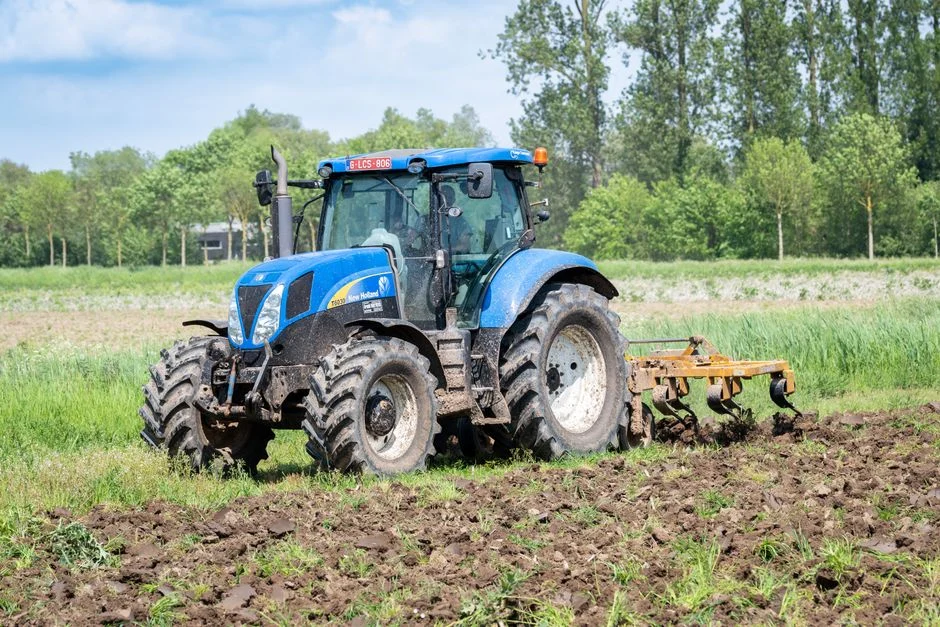
Rear tractor tire size chart: 38 sizes with diameter and circumference
Rear tires carry the weight and pull the load, so this is the chart most people come for. It lists 27 inch sizes and 11 metric sizes, from compact rears to the 710/70R42. Diameters are nominal. Real tires vary by brand and by how much tread is left.
| Size | Width in (mm) | Rim in (mm) | Overall diameter in (mm) | Circumference in (mm) |
|---|---|---|---|---|
| 11.2-24 | 11.2 (284) | 24.0 (610) | 43.0 (1,093) | 135.2 (3,434) |
| 12.4-24 | 12.4 (315) | 24.0 (610) | 45.1 (1,145) | 141.6 (3,597) |
| 13.6-24 | 13.6 (345) | 24.0 (610) | 47.1 (1,197) | 148.0 (3,760) |
| 14.9-24 | 14.9 (378) | 24.0 (610) | 49.3 (1,253) | 155.0 (3,936) |
| 16.9-24 | 16.9 (429) | 24.0 (610) | 52.7 (1,339) | 165.7 (4,208) |
| 12.4-28 | 12.4 (315) | 28.0 (711) | 49.1 (1,247) | 154.2 (3,916) |
| 13.6-28 | 13.6 (345) | 28.0 (711) | 51.1 (1,298) | 160.6 (4,079) |
| 14.9-28 | 14.9 (378) | 28.0 (711) | 53.3 (1,355) | 167.5 (4,256) |
| 16.9-28 | 16.9 (429) | 28.0 (711) | 56.7 (1,441) | 178.2 (4,527) |
| 18.4-28 | 18.4 (467) | 28.0 (711) | 59.3 (1,506) | 186.2 (4,730) |
| 20.8-28 | 20.8 (528) | 28.0 (711) | 63.4 (1,609) | 199.1 (5,056) |
| 14.9-30 | 14.9 (378) | 30.0 (762) | 55.3 (1,405) | 173.8 (4,415) |
| 16.9-30 | 16.9 (429) | 30.0 (762) | 58.7 (1,492) | 184.5 (4,686) |
| 18.4-30 | 18.4 (467) | 30.0 (762) | 61.3 (1,557) | 192.5 (4,890) |
| 20.8-30 | 20.8 (528) | 30.0 (762) | 65.4 (1,660) | 205.3 (5,215) |
| 12.4-32 | 12.4 (315) | 32.0 (813) | 53.1 (1,348) | 166.8 (4,236) |
| 24.5-32 | 24.5 (622) | 32.0 (813) | 73.7 (1,871) | 231.4 (5,877) |
| 16.9-34 | 16.9 (429) | 34.0 (864) | 62.7 (1,593) | 197.1 (5,006) |
| 18.4-34 | 18.4 (467) | 34.0 (864) | 65.3 (1,658) | 205.1 (5,209) |
| 20.8-34 | 20.8 (528) | 34.0 (864) | 69.4 (1,762) | 217.9 (5,535) |
| 23.1-34 | 23.1 (587) | 34.0 (864) | 73.3 (1,861) | 230.2 (5,847) |
| 13.6-36 | 13.6 (345) | 36.0 (914) | 59.1 (1,502) | 185.7 (4,718) |
| 14.9-38 | 14.9 (378) | 38.0 (965) | 63.3 (1,609) | 199.0 (5,054) |
| 16.9-38 | 16.9 (429) | 38.0 (965) | 66.7 (1,695) | 209.6 (5,325) |
| 18.4-38 | 18.4 (467) | 38.0 (965) | 69.3 (1,760) | 217.6 (5,528) |
| 20.8-38 | 20.8 (528) | 38.0 (965) | 73.4 (1,863) | 230.5 (5,854) |
| 23.1-38 | 23.1 (587) | 38.0 (965) | 77.3 (1,963) | 242.8 (6,166) |
| 320/85R24 | 12.6 (320) | 24.0 (610) | 45.4 (1,154) | 142.7 (3,624) |
| 340/85R24 | 13.4 (340) | 24.0 (610) | 46.8 (1,188) | 146.9 (3,731) |
| 380/85R24 | 15.0 (380) | 24.0 (610) | 49.4 (1,256) | 155.3 (3,945) |
| 420/85R24 | 16.5 (420) | 24.0 (610) | 52.1 (1,324) | 163.7 (4,158) |
| 420/85R28 | 16.5 (420) | 28.0 (711) | 56.1 (1,425) | 176.3 (4,477) |
| 460/85R30 | 18.1 (460) | 30.0 (762) | 60.8 (1,544) | 191.0 (4,851) |
| 480/80R34 | 18.9 (480) | 34.0 (864) | 64.2 (1,632) | 201.8 (5,126) |
| 520/85R38 | 20.5 (520) | 38.0 (965) | 72.8 (1,849) | 228.7 (5,809) |
| 600/65R28 | 23.6 (600) | 28.0 (711) | 58.7 (1,491) | 184.4 (4,685) |
| 650/65R38 | 25.6 (650) | 38.0 (965) | 71.3 (1,810) | 223.9 (5,687) |
| 710/70R42 | 28.0 (710) | 42.0 (1,067) | 81.1 (2,061) | 254.9 (6,474) |
Circumference here is diameter × 3.14, so it is a geometric figure. We explain below why a real tire rolls a little shorter.
How accurate is this chart?
Close. We checked against maker data we could open:
- 520/85R38: we compute 72.8 in (1,849 mm). Michelin lists 72.8 in for its Agribib 2 on a dealer page. Firestone lists 1,851 mm for the Performer 85. Titan's row-crop chart lists 1,854 mm
- 18.4R34: we compute 65.3 in (1,658 mm) with the 85% rule. Titan lists 1,676 mm (66 in), so the rule is 1.1% low
Read the table by rim first. On the same 38 in rim, a 16.9-38 stands 66.7 in (1,695 mm) and a 20.8-38 stands 73.4 in (1,863 mm). That is a 6.7 in (168 mm) gap with the same rim. For the very big rears, our big tractor tires guide covers what changes above 70 in (1,780 mm). For pairing and treads, see rear tractor tires.
Front, garden and flotation sizes: smaller tires, same maths
Front tires steer, so they are narrower than the rears. The table below covers fronts, flotation implement tires and garden tires in one place. Front diameters are estimates from the 85% rule. Narrow ribbed fronts can come out taller than the rule says, so read the number off the tire you are replacing.
| Size | Typical use | Width in (mm) | Rim in (mm) | Overall diameter in (mm) |
|---|---|---|---|---|
| 6.00-16 | Front tractor (est.) | 6.0 (152) | 16.0 (406) | 26.2 (665) |
| 6.50-16 | Front tractor (est.) | 6.5 (165) | 16.0 (406) | 27.1 (687) |
| 7.50-16 | Front tractor (est.) | 7.5 (191) | 16.0 (406) | 28.8 (730) |
| 9.5-16 | Front tractor (est.) | 9.5 (241) | 16.0 (406) | 32.2 (817) |
| 10.00-16 | Front tractor (est.) | 10.0 (254) | 16.0 (406) | 33.0 (838) |
| 12.4-16 | Front tractor (est.) | 12.4 (315) | 16.0 (406) | 37.1 (942) |
| 10.0/75-15.3 | Flotation implement | 10.0 (254) | 15.3 (389) | 30.3 (770) |
| 12.5/80-15.3 | Flotation implement | 12.5 (318) | 15.3 (389) | 35.3 (897) |
| 12.5/80-18 | Flotation implement | 12.5 (318) | 18.0 (457) | 38.0 (965) |
| 15.0/55-17 | Flotation implement | 15.0 (381) | 17.0 (432) | 33.5 (851) |
| 19.0/45-17 | Flotation implement | 19.0 (483) | 17.0 (432) | 34.1 (866) |
| 18x8.50-10 | Garden and compact | 8.5 (216) | 10.0 (254) | 18.0 (457) |
| 20x8.00-10 | Garden and compact | 8.0 (203) | 10.0 (254) | 20.0 (508) |
| 23x8.50-12 | Garden and compact | 8.5 (216) | 12.0 (305) | 23.0 (584) |
| 26x12.00-12 | Garden and compact | 12.0 (305) | 12.0 (305) | 26.0 (660) |
| 27x8.50-15 | Garden and compact | 8.5 (216) | 15.0 (381) | 27.0 (686) |
Garden tires use a different code. In 23x8.50-12 the first number is the overall height: 23 in (584 mm). Then comes the width, 8.5 in (216 mm), and the rim, 12 in (305 mm). No arithmetic needed. The garden rows above use rims from 10 to 15 in (254 to 381 mm).
On a tractor with front-wheel assist, the fronts must work as a pair with the rears. Our front tractor tires guide explains how. For wide, low implement tires, see flotation tires and implement tires.
How do you convert a standard tractor tire size to metric?
Multiply the inch width by 25.4 to get millimeters. Old inch sizes generally match an 85% aspect ratio, according to the Eil-Bulldog conversion guide. That gives 14.9-28 ≈ 380/85R28, 16.9-38 ≈ 420/85R38 and 20.8-38 ≈ 520/85R38. Our table adds the part most charts skip: how far apart the two diameters really are.
| Standard size | Metric near-match | Standard diameter in (mm) | Metric diameter in (mm) | Difference | Real speed when display reads 10 mph (16 km/h) |
|---|---|---|---|---|---|
| 12.4-24 | 320/85R24 | 45.1 (1,145) | 45.4 (1,154) | +0.3 in (+9 mm), +0.7% | 10.1 mph (16.2 km/h) |
| 13.6-24 | 340/85R24 | 47.1 (1,197) | 46.8 (1,188) | −0.4 in (−9 mm), −0.8% | 9.9 mph (16.0 km/h) |
| 14.9-24 | 380/85R24 | 49.3 (1,253) | 49.4 (1,256) | +0.1 in (+3 mm), +0.2% | 10.0 mph (16.1 km/h) |
| 16.9-24 | 420/85R24 | 52.7 (1,339) | 52.1 (1,324) | −0.6 in (−16 mm), −1.2% | 9.9 mph (15.9 km/h) |
| 14.9-28 | 380/85R28 | 53.3 (1,355) | 53.4 (1,357) | +0.1 in (+3 mm), +0.2% | 10.0 mph (16.1 km/h) |
| 16.9-28 | 420/85R28 | 56.7 (1,441) | 56.1 (1,425) | −0.6 in (−16 mm), −1.1% | 9.9 mph (15.9 km/h) |
| 18.4-30 | 460/85R30 | 61.3 (1,557) | 60.8 (1,544) | −0.5 in (−13 mm), −0.8% | 9.9 mph (16.0 km/h) |
| 18.4-34 | 460/85R34 | 65.3 (1,658) | 64.8 (1,646) | −0.5 in (−13 mm), −0.8% | 9.9 mph (16.0 km/h) |
| 16.9-38 | 420/85R38 | 66.7 (1,695) | 66.1 (1,679) | −0.6 in (−16 mm), −0.9% | 9.9 mph (15.9 km/h) |
| 18.4-38 | 460/85R38 | 69.3 (1,760) | 68.8 (1,747) | −0.5 in (−13 mm), −0.7% | 9.9 mph (16.0 km/h) |
| 20.8-38 | 520/85R38 | 73.4 (1,863) | 72.8 (1,849) | −0.6 in (−14 mm), −0.8% | 9.9 mph (16.0 km/h) |
Every pair lands within 1.2% of the other in height. The metric tire is the shorter one in 8 of the 11 rows. The last column assumes your speedometer was set up for the standard size. A 1% taller tire makes the tractor travel 1% faster than the display says. Close is not identical, so use the tire size converter for any size not shown here.
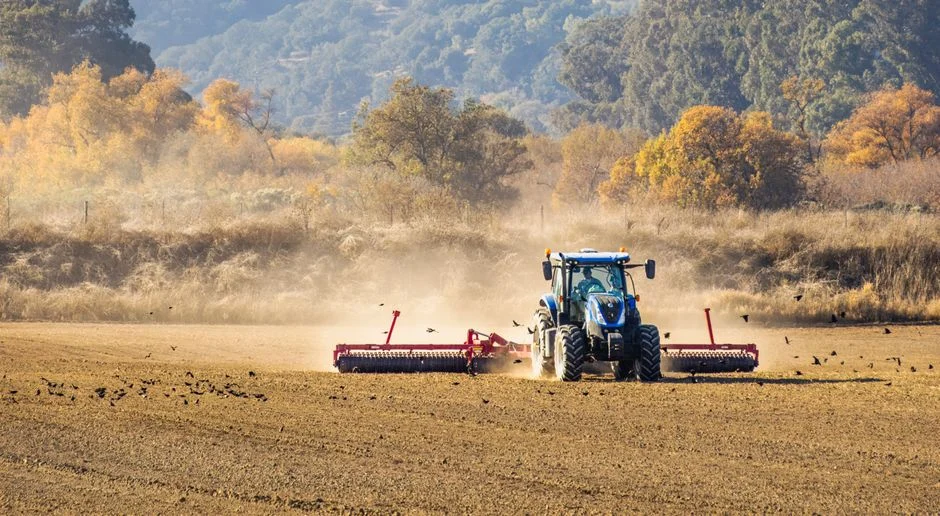
A lower aspect ratio makes the tire shorter without changing the rim
Width and height are not the same thing. The table keeps the rim at 38 in (965 mm) and changes the series.
| Size | Width in (mm) | Aspect ratio | Sidewall in (mm) | Overall diameter in (mm) |
|---|---|---|---|---|
| 420/85R38 | 16.5 (420) | 85% | 14.1 (357) | 66.1 (1,679) |
| 480/70R38 | 18.9 (480) | 70% | 13.2 (336) | 64.5 (1,637) |
| 520/85R38 | 20.5 (520) | 85% | 17.4 (442) | 72.8 (1,849) |
| 540/65R38 | 21.3 (540) | 65% | 13.8 (351) | 65.6 (1,667) |
| 600/65R38 | 23.6 (600) | 65% | 15.4 (390) | 68.7 (1,745) |
| 650/65R38 | 25.6 (650) | 65% | 16.6 (423) | 71.3 (1,810) |
A 540/65R38 is 20 mm wider than a 520/85R38 but 7.2 in (182 mm) shorter. A 650/65R38 is 130 mm wider and only 1.5 in (39 mm) shorter. So a wider tire does not always mean a taller one. That is why we say check the diameter first.
Diameter, circumference and rolling circumference are three different numbers
Diameter tells you if the tire clears the fender. Circumference is diameter × 3.14. Rolling circumference is how far the tractor really moves per turn. It is shorter, because the tire flattens under load.
Here is a worked example on a 520/85R38. Geometric circumference: 3.14 × 1,851 mm gives about 5,815 mm (229 in). Firestone lists a rolling circumference of 5,553 mm (219 in), and Titan's chart lists 5,550 mm. That is about 4.5% shorter than the geometric figure. If you need ground speed or seed rate to be right, measure the rolling circumference on your own tractor. The tire diameter calculator does the geometric part for you.
Now the swap. Replace an 18.4-38 (69.3 in, 1,760 mm) with a 520/85R38 (72.8 in, 1,849 mm) and the tire is 5.1% taller. The display says 10 mph (16 km/h) and the tractor does 10.5 mph (16.9 km/h). Nobody asked the speedometer.
Can you put a different size tire on your tractor?
Sometimes. Run through this list before you buy. Tread carefully, because a wrong size costs more than a wrong joke.
- Match the rim diameter exactly. A 38 in rim takes a 38 in tire.
- Keep the overall diameter within what your tractor maker allows. It is in the operator's manual.
- Check the width against the fenders and your wheel track setting.
- Keep one construction, bias or radial, on each axle.
- Check the load index is at least what the old tire carried. Use the load index and speed rating chart.
- On four-wheel assist, change fronts and rears together and run the numbers in the lead-lag calculator.
The last point matters most. The front axle is geared to turn at a set ratio to the rear. Change one end and you change that ratio. The manual lists the range your tractor allows.
Does bias or radial change the size?
Not the size, only the build. A dash in 18.4-38 means bias-ply. An R in 520/85R38 means radial. We are not biased. Well, one of them is. According to University of Kentucky Extension, radials give better fuel efficiency but need more careful pressure management. Our catalog has 40 bias, 28 radial and 1 VF model listings. The radial vs bias-ply guide covers the trade-offs.
The tread code is separate from the size
R-1 is the standard farm lug. R-3 is a shallow turf pattern. R-4 is an industrial pattern. F-2 is a ribbed front tire. One size can come in several of these. Start with R1 vs R2 vs R3 vs R4, then R1 vs R1W. The tread type picker narrows it down for your work.
Load and pressure matter as much as the size
The right size at the wrong pressure still gives you a bad day. University of Kentucky Extension advises running the lowest pressure the maker's load table allows for your load. Our tractor tire pressure guide shows how to set it. Speed matters too. Per the ETRTO and TRA speed symbol table, A8 is 25 mph (40 km/h), B is 31 mph (50 km/h) and D is 40 mph (65 km/h).

How do you measure the tire you have?
Start with the sidewall. The biggest code molded into the rubber is the size. If it is worn off, measure.
- Take a photo of the sidewall first. Even half a code helps.
- Measure the width at the widest point of the sidewall.
- Read the rim diameter on the rim or at the tire bead.
- Measure the overall diameter from the ground to the top of the tread. A tire under load reads a little less than its catalog figure.
- Mark the tire and the ground, drive one full turn, and measure the distance. That is your rolling circumference.
[Puts on reading glasses. Squints at sidewall.] If it still looks like hieroglyphics, send us the photo. We read them for a living.
Seven size mistakes that cost money
- Matching the width and ignoring the diameter
- Treating an inch and a metric near-match as identical (they differ by up to 1.2% above)
- Changing tires on one end of a four-wheel-assist tractor
- Mixing bias and radial on the same axle
- Trusting a nominal chart over the sidewall
- Buying a tire with the wrong rim diameter
- Setting pressure by habit instead of by the load table
Which sizes do we list?
Our catalog holds 69 tire model listings across 85 sizes from 20 brands. Every size has its own page in the size browser at the top of this page. By tread code, 17 listings are R-1, 14 are R-1W, 9 are F-2, 8 are I-1 and 1 is R-4.
| Size group | Sizes on our list | Examples |
|---|---|---|
| Garden and compact | 5 | 18x8.50-10, 20x8.00-10, 23x8.50-12, 26x12.00-12 |
| Metric radial rears and fronts | 11 | 320/85R24, 340/85R24, 380/85R24, 420/85R24 |
| Metric flotation on 22.5 and 26.5 in rims | 4 | 560/60R22.5, 600/50R22.5, 650/55R26.5, 710/50R26.5 |
| Skid steer, industrial and truck | 6 | 10-16.5, 10R16.5, 12-16.5, 14-17.5 |
| Flotation and implement | 14 | 10.0/75-15.3, 11L-15, 11L-16, 12.5/80-15.3 |
| Small-rim fronts and utility | 11 | 10.00-16, 12.4-16, 5.00-15, 5.50-16 |
| Standard inch rears | 34 | 11.2-24, 11.2-28, 12.4-24, 12.4-28 |
| All groups | 85 | 69 model listings across these sizes |
We are a quote-based supplier of new and used tires, based in Bangkok. We ship to the USA and Europe in about 1 week, and you pay by Zelle. For used tires, the supplier sends photos of the actual tire on request. Browse the tractor tires catalog or all tire listings. Worried about a used tire? Read how to inspect used tractor tires, or see what tires cost by size.
When you don't need this chart
Honest answer: most of the time. If your current size fits, works and has tread left, buy the same size. You do not need a conversion at all. The chart is for the odd occasion when the old size is gone, or the manual allows a change and you want the numbers. If your manual says no, the answer is no. We would rather tell you than sell you a tire you do not need.
Still stuck on a number? Send us your size or a photo of the sidewall on WhatsApp. We will find the tire. We will probably make a tread joke too. Consider it free.
Questions
What does 18.4-38 mean on a tractor tire?
18.4 is the width in inches (467 mm) and 38 is the rim diameter in inches (965 mm). The dash means bias-ply. The tire stands about 69.3 in (1,760 mm) tall, using the 85% sidewall rule.
What is the metric equivalent of 18.4-38?
The near-match is 460/85R38. By our maths the standard size is 69.3 in (1,760 mm) and the metric one is 68.8 in (1,747 mm), so the metric tire is 0.7% shorter. Close, but check your manual before you swap.
How tall is a 520/85R38 tractor tire?
About 72.8 in (1,849 mm). That is a 38 in rim (965 mm) plus two sidewalls of 17.4 in (442 mm). Firestone lists 1,851 mm for its Performer 85 in this size.
How do I calculate tractor tire diameter?
For metric sizes, diameter = rim in inches × 25.4 + 2 × width in mm × aspect ratio. For inch sizes, add the rim to two sidewalls of 85% of the width. Treat the result as nominal, since real tires vary by brand and tread depth.
How do I find my tractor tire size?
Look at the sidewall. The size is the biggest code molded in, such as 18.4-38 or 520/85R38. If it is worn off, measure width, rim and overall diameter, or send us a photo and the tractor model.
Can I put a different size tire on my tractor?
Sometimes. Keep the rim diameter the same, keep the overall diameter within what your manual allows, and check fender clearance and load index. On four-wheel assist, change fronts and rears together.
Do front and rear tractor tires have to match?
On a tractor with front-wheel assist, yes. The front and rear sizes must work as a pair because the front axle is geared to a set ratio to the rear. On a two-wheel-drive tractor the fronts only steer, so the rule is looser. Check your manual either way.
Are 13.6-28 and 340/85R28 the same size?
They are near-equivalents, not twins. By our maths the 13.6-28 stands 51.1 in (1,298 mm) and the 340/85R28 stands 50.8 in (1,289 mm), which is 0.7% shorter. The 13.6 in width is also 345 mm against 340 mm.
Does a bigger tire change my speed?
Yes. A 1% taller tire makes the tractor travel 1% faster than the display says. Swapping an 18.4-38 for a 520/85R38 is 5.1% taller, so 10 mph (16 km/h) on the display becomes about 10.5 mph (16.9 km/h).
What is the most common rear tractor tire size?
There is no single answer, because it depends on tractor size. Compact tractors often run 12.4-24, mid-size utility tractors 14.9-28 or 16.9-30, and large row-crop tractors 18.4-38 or 520/85R38. Read the size on the tire you are replacing.