
Industrial
Industrial Tires
Industrial tires carry loaders, backhoes, skid steers and yard tractors on concrete, gravel and packed dirt. Tractor loaders and backhoes mostly run R-4 industrial tread; skid steers use their own sizes such as 10-16.5 and 12-16.5. Find your size below, add it to a quote or send it on WhatsApp.
- 11sizes listed
- New & usedcondition options
- 20brands sourced
- About 1 weekshipping to the USA & Europe
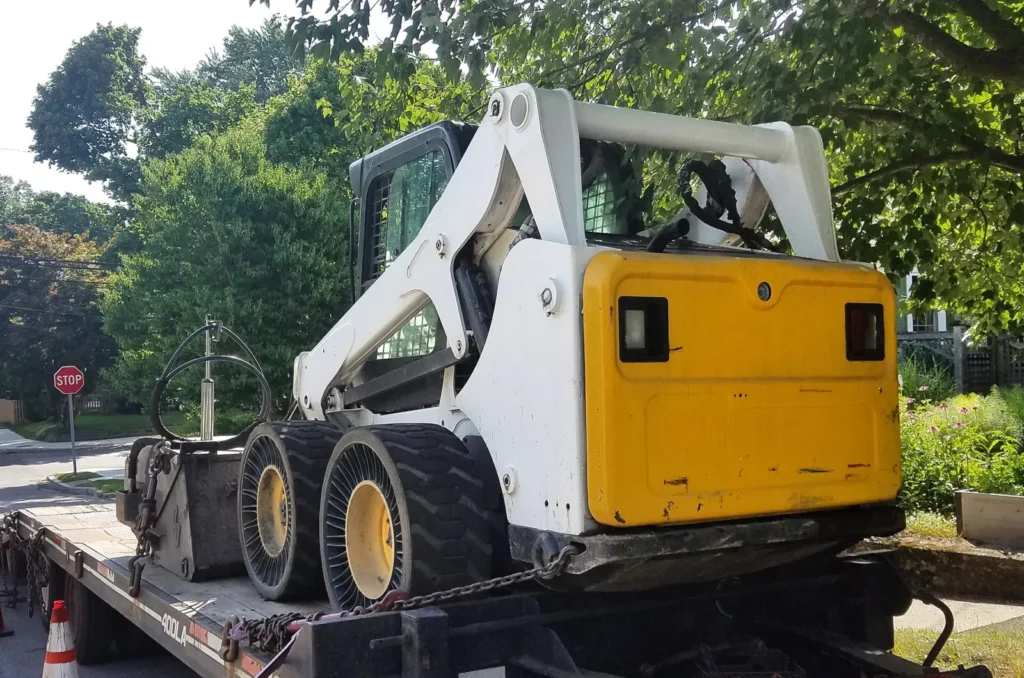

Industrial Tires sizes
Industrial Tractor Tires
Skid Steer Tires
That size isn’t in this list — we can often still source it. Ask us on WhatsApp
Choosing industrial tires
R-4: the industrial tractor tread
R-4 has shorter, closer lugs than a farm R-1 tread. That gives a stable footprint on hard surfaces and a smoother ride on concrete and gravel, while still gripping in dirt. It is the usual tread for tractor loaders, backhoes and yard tractors. If your machine works mainly in soft fields, an R-1 farm tread pulls better.
Skid steer tires
Skid steers turn by skidding, so their tires take heavy side loads and wear fast on hard ground. Sizes such as 10-16.5 and 12-16.5 are the most common; larger machines use 14-17.5 and 15-19.5. A wider size gives more flotation on soft ground but needs clearance in the wheel well. Replace all four tires together so the machine tracks straight.
Load comes first
Loader work puts a lot of weight on the front axle, especially with a full bucket. Match or exceed the load rating (load index or ply rating) of your current tires, and tell us the machine model so we can check.
Bias or radial
Most industrial and skid steer tires are bias-ply, which keeps the sidewall stiff and the machine steady under a raised load. Radial options such as 10R16.5 ride smoother and can last longer on hard surfaces, at a higher price.
Pneumatic, foam-filled or solid skid steer tires?
Compact Equipment splits skid steer tires into three groups. Air-filled pneumatic tires cost least and ride best, but they puncture. Foam-filled pneumatics resist punctures far better and suit construction sites, at a higher price. Solid tires cost most up front, often last longer and cannot go flat, though a solid on a 20-inch rim carries less rubber, and so less cushion, than one on a 16-inch rim. If you run through scrap, demolition debris or glass, foam-filled or solid is worth pricing. For clean ground and yard work, air is fine.
How do you match skid steer tire size to your machine?
Pneumatic sizes show two numbers, width and rim diameter in inches, so 12-16.5 is 12 inches wide on a 16.5-inch rim. The base sizes are 10-16.5, 12-16.5 and 14-17.5. Overall diameter is not in the size, and it matters. McLaren Industries gives approximate outer diameters of 30 to 31 inches (76 to 79 cm) for 10-16.5, 32.5 to 33 inches (83 to 84 cm) for 12-16.5 and 36 to 36.5 inches (91 to 93 cm) for 14-17.5. A tire that is too small stops an attachment such as a grapple bucket from seating level on the arms, which costs rigidity and lifting power. One that is too large leaves the bucket hovering and strains the hydraulic cylinders. Check the size on your current tires against the size pages, and send us your machine model on WhatsApp if you are unsure.
How do you make skid steer tires last?
- Check pressure daily on pneumatics. Under-inflation causes blowouts and faster wear.
- Inspect the tread for uneven wear, chunking, cuts and gouges. Uneven wear usually points to a problem elsewhere.
- Clean the tires. Caked dirt and rocks speed up wear.
- Match the tread to the ground: hard-surface tread in mud can leave you stuck, and all-terrain tread on pavement wears early and rides rough.
- Drive slowly on hard ground and avoid needless skidding. Aggressive driving on pavement wears tires much faster than steady work on soft ground.
Questions
What is an R-4 tire?
R-4 is the industrial tread code: shorter, closer lugs than a farm R-1 tire, for stability and wear on hard surfaces while still gripping in dirt. It is standard on tractor loaders and backhoes.
What is the most common skid steer tire size?
10-16.5 and 12-16.5 are the most common. Larger skid steers use 14-17.5 or 15-19.5. Check the size on your current tire sidewall.
Should I replace all four skid steer tires at once?
Yes, ideally. Skid steers steer by speed differences between the sides, so uneven tire sizes or wear make the machine pull and wear the drivetrain.
Do you sell used industrial tires?
Yes. We supply new and used industrial and skid steer tires. Ask for the tread remaining and photos before you buy.
Are foam-filled skid steer tires worth it?
If you work around debris, scrap or demolition material, yes. Foam-filled tires resist punctures much better than air-filled ones, at a higher price. For clean yard work, standard air-filled tires are usually enough.
How do I know what outer diameter my skid steer tire has?
It is not in the size. Approximate figures are 30 to 31 inches for 10-16.5, 32.5 to 33 inches for 12-16.5 and 36 to 36.5 inches for 14-17.5. Measure your current tire to confirm.